School Children Books Globe Chalkboard Graphics
As a graphic designer who has spent years refining brand identities and creating marketing visuals for small businesses, I approach every new graphic design asset with a critical eye. It is not enough for an image to be cute; it must be functional, versatile, and capable of carrying a narrative. Recently, I evaluated the School Children Books Globe Chalkboard collection for a potential client project involving a boutique educational supply store. This review breaks down how this specific set of Illustrations performs in real-world design scenarios, moving beyond simple aesthetics to practical application.
First Impressions: Nostalgia Meets Modern Simplicity
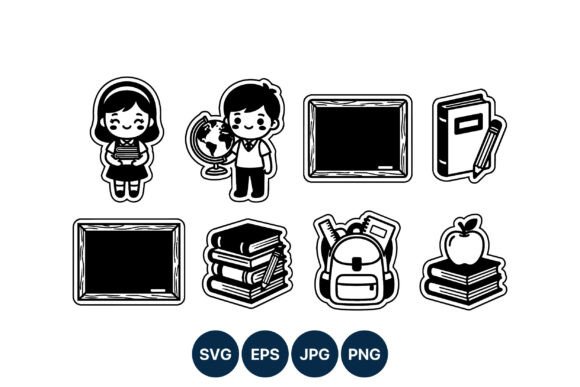
The immediate visual impact of the School Children Books Globe Chalkboard assets is one of warm, academic nostalgia. The black and white vector art style creates a clean, high-contrast look that feels both timeless and contemporary. The imagery features two children holding a globe and books, surrounded by classic school motifs like wooden chalkboards, stacked books with pencils, backpacks filled with supplies, and the iconic apple resting on a pile of texts.
For a designer, this monochromatic approach is a gift. It removes the headache of color matching during the initial concept phase. The line work is crisp, suggesting a hand-drawn quality that adds human touch to digital formats. This mood fits perfectly with projects aiming for a handmade, artisanal, or vintage-inspired aesthetic. It is not just clipart; it is a foundational element for building a cohesive brand identity that values tradition and learning.
Versatility in Client Projects
When considering where these Graphics fit best, the applications are surprisingly broad. I tested these elements across several mockups to gauge their flexibility. Here is how they perform in specific design contexts:
- Packaging Design: The detailed illustrations of stacked books and globes work exceptionally well on kraft paper labels or minimalist product boxes for stationery. The black ink on natural brown paper creates a sophisticated, organic look that appeals to eco-conscious consumers.
- Print-on-Demand and Apparel: For t-shirt design or tote bags, the vector nature of these files ensures scalability. The children holding the globe make for a strong central graphic on apparel, conveying messages of global education or community without needing excessive text.
- Digital Products and Printables: If you are creating an Etsy product such as homeschool planners or classroom decor, these assets are ideal. They serve as excellent headers for worksheets or decorative corners for printable wall art. The SVG design format allows for easy resizing without loss of quality, which is crucial for digital sellers.
- Social Media Graphics: In Canva templates for teachers or educational bloggers, these illustrations add visual interest to Instagram posts and Pinterest pins. They break up text-heavy layouts and provide a friendly, approachable vibe that increases audience engagement.
Strategic Placement and Visual Hierarchy
Understanding where to place these assets is key to maintaining professional visual hierarchy. The School Children Books Globe Chalkboard elements are detailed. Therefore, they shine best in large layout areas or as hero graphics on landing pages. When used as a focal point, they draw the eye effectively. However, designers must be cautious when using them as background patterns or in crowded layouts. The intricate lines of the backpack supplies and chalkboard textures can become visually noisy if scaled down too small or placed over complex backgrounds.
For logo design, I recommend isolating single elements, such as the apple on books or the globe, rather than using the entire composite scene. This ensures the mark remains recognizable at favicon sizes. For marketing visuals like flyers and posters, the full composition works well to establish a theme, provided there is ample white space around the illustration to let it breathe.
Technical Considerations for Professional Use
Before integrating any digital product into a client deliverable, technical due diligence is required. Here are my practical notes for working with this specific asset pack:
- Contrast Testing: Since these are black and white vectors, they rely heavily on contrast. Always test them on both light and dark backgrounds. On dark backgrounds, you will need to invert the colors to white or a light accent color to maintain visibility.
- File Format Inspection: The download includes a ZIP folder, typically containing SVG and PNG files. For Cricut projects and vinyl cutting, the SVG files are superior because they allow for clean cut paths. For web design and sublimation printing, ensure the PNG files have transparent backgrounds to avoid ugly white boxes around your graphics.
- Typography Pairing: These illustrations pair beautifully with serif fonts for a classic academic look, or handwritten fonts for a playful, child-friendly feel. Avoid overly decorative display fonts that might compete with the detailed line work of the chalkboards and books.
- Print Quality: Always preview the vector files at 100% zoom to check for any stray nodes or imperfect curves. While rare in professional assets, a quick cleanup in Illustrator or Inkscape can ensure perfect print quality for high-end commercial design outputs.
Licensing and Commercial Viability
For freelancers and agency designers, the most critical aspect is the license. Whether you are creating a design bundle for resale or a one-off product mockup for a local business, you must confirm the commercial licensing terms. Most assets from creative marketplaces allow for use in end-products like t-shirts and mugs, but restrict the resale of the raw digital files. Always read the fine print to protect your client and your business.
The School Children Books Globe Chalkboard collection offers significant value for small business branding in the education and lifestyle sectors. It provides a ready-made visual language that communicates trust, learning, and creativity. By understanding its strengths in editorial design and its limitations in small-scale applications, designers can leverage these Illustrations to create polished, professional, and emotionally resonant projects. Whether for a sublimation design on a mug or a comprehensive web design layout, this asset proves that classic imagery, when executed with clean vector precision, remains a powerful tool in the modern designer's toolkit.